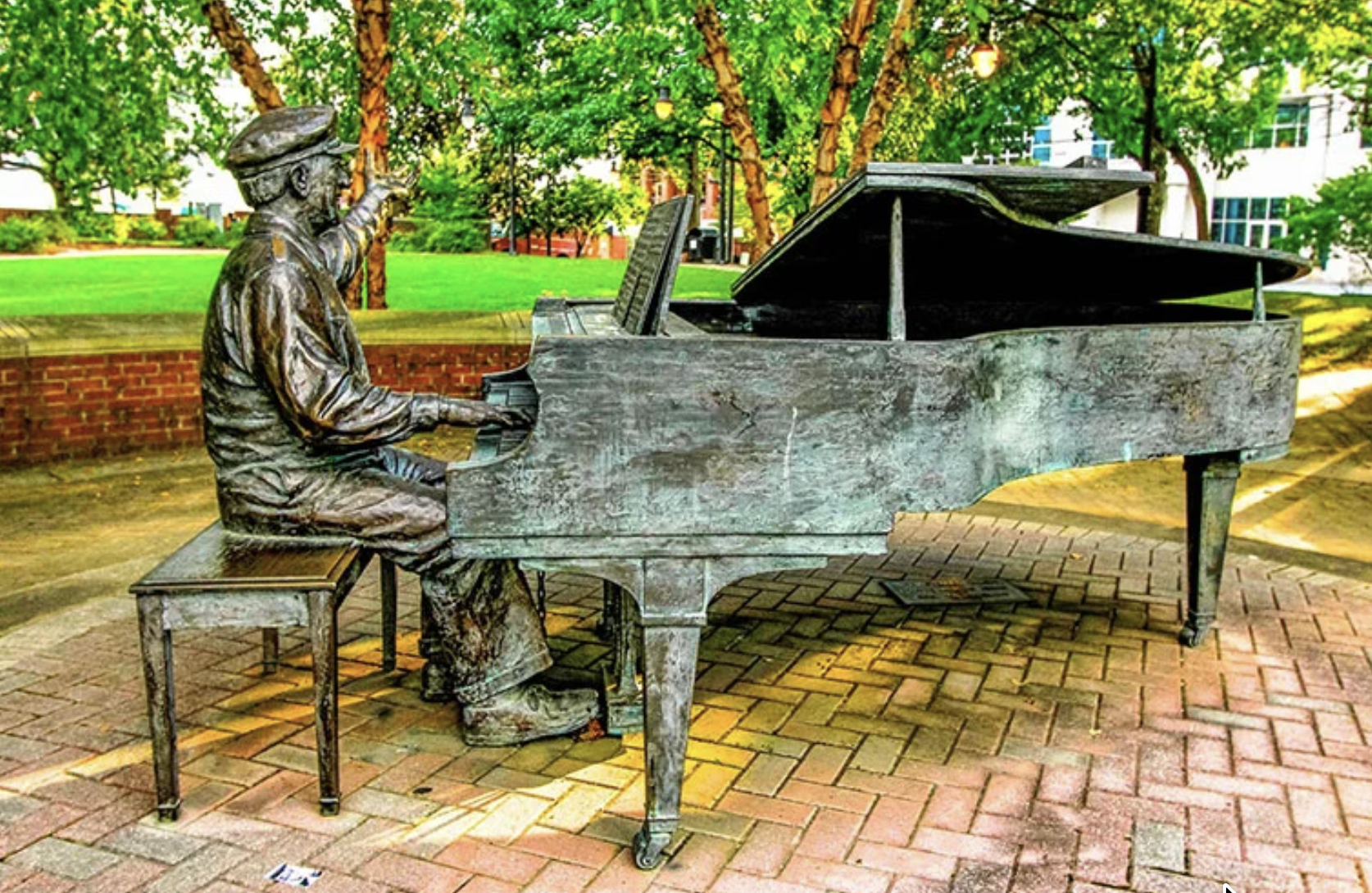
If you walk to the very top of Music Row — where 16th and 17th Avenue South meet at that little roundabout — you'll find a small park with a bronze man sitting at a piano. Most people walk right past him. Don't be most people.
That's Owen Bradley, and that tiny patch of grass is doing a lot more storytelling than its size suggests.
Here's the thing about Owen Bradley Park: it used to be a gas station. A Double Eagle Service Station, to be exact. In 1974, the city turned the lot into a park — originally called Music Square Park — and it sat there quietly for over twenty years before getting its current name and its most famous resident: a life-size bronze statue of Bradley, unveiled in 1999, captured mid-performance at his piano.
So who was Owen Bradley, and why does he get a statue while the rest of Music Row just gets buildings?
Bradley was a Big Band leader and staff musician at WSM back in the 1940s. When Decca Records came to Nashville to record Ernest Tubb in 1947, Bradley was the guy who pulled the session together — rounding up musicians, smoothing things over, making it work. That session helped put Nashville on the map as a place where records got made, not just played.
From there, Bradley didn't slow down. He built the first studio on what we now call Music Row, and over the following decades he produced an absurd list of country legends: Patsy Cline, Loretta Lynn, Brenda Lee, Kitty Wells, Conway Twitty, Ernest Tubb, Red Foley. If you've ever heard a Patsy Cline song with those lush strings behind her voice — that smooth, polished, "Nashville Sound" — that's Bradley's fingerprints all over it. He and his contemporary Chet Atkins basically took country music out of the honky-tonk and gave it a sound that could play on pop radio. Bradley was inducted into the Country Music Hall of Fame in 1974.
Walk around the statue and you'll notice the sidewalk is lined with inscriptions — names of the artists Bradley worked with, a quiet roll call of country music royalty, right there under your feet.
It's easy to miss this park. It's small, it's tucked at the edge of the roundabout, and it doesn't shout for attention. But that's kind of perfect, isn't it? Some of the most important things in Music Row's story didn't happen in flashy buildings — they happened because one guy showed up, organized the chaos, and quietly changed what country music sounded like.
Next time you're walking by, take thirty seconds. Sit on the bench. Say hi to Owen. He basically built the neighborhood you're standing in.